____________________________________________
Thank you to The Tip Junkie!
How to Thread your Machine
The BEST help for threading a sewing machine is the machine itself AND the machine’s manual. Unfortunately, a lot of well loved {used} machines don’t come with a manual and sometimes {er, this NEVER happens} we misplace the manual that did come with our machine. Thankfully, most machines give you a step-by-step guide right on their body.
 In order to sew, you need two sewing threads. An upper thread {the stitches you see on the top of your piece} and a bobbin {the stitches on the underside of your piece}. In order to wind a bobbin, your machine can not be already threaded and ready to sew {as you need it to go onto the bobbin}. That is why we will cover this step first.
** There are a few machines {like mine} that will wind the bobbin independent of the upper thread, but this is not as common. **
How To Thread A Bobbin
Typically the bobbin threader {winder} is on the top right of the machine and there is a second set of marked guides {usually a dashed line} on the machine to show you how to wind your bobbin. On my machine, then it goes from the spool, through the eyelet and then around a bobbin winding tension disk and over to the bobbin winder. I guide the thread from the underside of the bobbin to the top through the small hole on the outside edge of the bobbin.
 Place the bobbin on the bobbin winder spindle, click to the right to engage the bobbin winding and then push the bobbin winding button. Clip off the little tail from where you first wound the bobbin once it is wound. Cut the thread feeding from the spool and remove the bobbin from the winding pin.
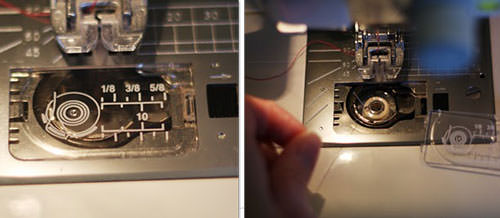
Drop your bobbin into the bobbin holder {the mechanism under the needle} and thread according to the guide. Your bobbin should unwind in a counter clockwise direction.
Threading A Sewing Machine
My machine is set up to accommodate two spools of thread, so my top thread {the one that creates the stitches on top of your project) sits upright at the back of my machine. A lot of machines have a horizontal spool pin that the thread goes onto on the top of the machine.
Place your thread {mine is hot pink … because it’s fun and easier for you to see in pictures} on the spool pin. You should be able to ‘lock’ your spool in place by placing a plastic spool holder in front of it to keep it from sliding off the pin while you sew.
 Follow the guide on your machine {referring to the manual as needed, if applicable}. Typically you’ll feed your thread through an eyelet {2 on my machine} and then click it into a thread guide {3 on my machine}. From there it will feed to the tension area on the left of your machine.
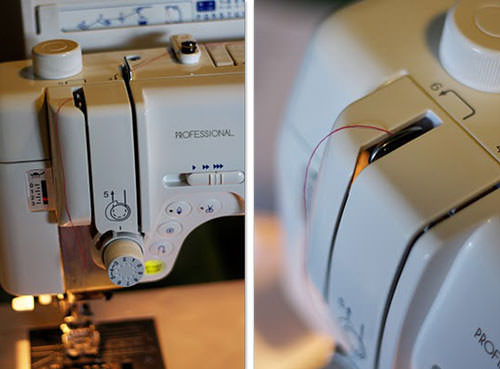 It should guide into a ‘slot’ {4} and then go down {around the tension dial – 5} and then back up to the thread take up arm {6} that rises up and down when you sew. Use your manual feed, handwheel {the large round knob on the far right end of your machine} to guide the arm to the top most position so you can guide your thread through it.
** I think this is the trickiest step of loading your machine. I always make this step harder than it has to be. If you look close, there should be a little ‘notch’ to guide your thread into the eye of the arm. **
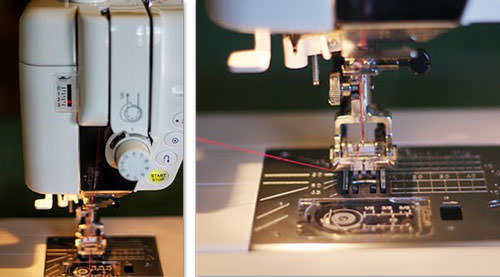 Then follow the remaining guides to get the thread down to your needle. I have an automatic threader which is handy, but with good light and a steady hand you can thread it manually just fine. I thread from the front of the needle to back.
 Once your top thread is in place, use your hand-wheel to lower your needle down and then back up. This should ‘grab’ your bobbin thread and bring it up with the top thread. You should have two pieces of thread now. Give them a light pull so you have about 3-5 inches of thread.
Congratulations!! You’re ready to start sewing!!If you’re looking for a tutorial for your specific machine, YouTube has a several great videos on how to thread your sewing machine and you can Google resources like downloadable manuals for old {and new} sewing machines.
I hope this post gave you the little push you needed to: pull out that machine you’ve been holding onto, ask to borrow one from a friend OR purchase one to work on growing your sewing skills.
_________________________________
Your Sewing Machine: Pieces & Parts
Overwhelmed by all the gizmos on your machine? No need to worry. I’m here to break it down just a little bit for you.
This will be a general overview with a few outside links to helpful articles, tutorials and explanations. I hope you find it helpful!
 Stitch Width & Length – There are two separate knobs. One for selecting width and another for selecting length. The larger the number you choose, the greater the stitch width or length. It may take some playing around with this to find your favorite setting.
Stitch Choices – Your machine may not have as many different stitch options as mine or it may have a ton more. This is where you decide what you want your stitch to look like. Depending on your choice, you may have to change the footer.
On my machine, the stitches are broken up into four different zones:
{1} Red: straight, zigzag and utility stitches
{2} Green: Geometric, decorative stitches
{3} Blue: Buttonhole
{4} Gold: Stretch stitches
Stitch Selector – On my particular machine, there is a large knob on the side that when turned switches between the different stitches.
Reverse Switch Control – I use this bad boy all. the. time. As soon as I start a new stitch, I always “lock” it in place by pressing down on that button. It causes the machine to back up the needle over the spot you just sewed. This locks the stitches and makes it difficult for any unraveling to occur.
If you’re looking for a more in-depth explanation of stitch length and width, check out this article.
 Handwheel – You can manually move the needle up and down by turning this knob. It also pops out to keep the needle from moving while I’m winding the bobbin with more thread.

Bobbin Thread Guide & Winder – There is a small image on the top of my machine that explains how to set up the thread in order to wind the bobbin. I’m assuming most machines have something very similar to this. The winder itself is where you place the bobbin.
In my dreams, I imagine a machine that automatically refills the bobbin before it runs out. I never have to stop sewing to wind the bobbin. I just keep right on sewing.
A girl can dream, right? ::wink::
 Extension Table & Free Arm Nine times out of ten you won’t need to remove the extension table . . . . unless you hem a lot of jeans and/or pants. Removing the extension table, makes it very easy to get smaller {tube shaped} items feed through the machine. Since I don’t hem all that many jeans {because that’s the thing nightmares are made of}, I don’t use the free arm feature very much, but it’s useful and there for me if I need it.
Kinda sorta related . . . . If you’re looking for a tutorial on how to hem jeans and keep the original bottom hem, look no further than here.
 Bobbin – Some machines have a metal case you place the bobbin inside and others, like mine, just set down inside an inset. Please ignore the lint. I thought about dusting, but . . . . er, didn’t. ::wink::
Sewing Guides – Also called Seam Guide or Guide Lines. The lines on the needle plate help you measure seam width. Those lines are your friend. Use them. Um, that doesn’t sound right. I’m not suggesting you use your friends. ::snort::
 Feed Balancing Dial – The only time you’ll need to use this is if your stitch pattern appears uneven or distorted. In the twelve plus years I’ve been sewing, I’ve only used this dial a handful of times.
Thread Tension Dial – You’ll definitely want to make sure your needle thread tension is set correctly. If it’s too loose, the needle thread will show through on the wrong side of the fabric and feel bumpy. If it’s too tight, the bobbin thread will show through on the right side of the fabric and feel bumpy. Sometimes you may need to adjust tension depending on the type of fabric and/or number of fabrics you are sewing.
If you want to understand more, here is a great article on Understanding Thread Tension.
Some of these parts may look slightly different or be located in a different spot on your machine than mine, but this should be a good launching point. Your manual is your best friend when it comes to figuring out parts and functions. Well . . . . that and Google. ::wink::

Drop your bobbin into the bobbin holder {the mechanism under the needle} and thread according to the guide. Your bobbin should unwind in a counter clockwise direction.
Threading A Sewing Machine
My machine is set up to accommodate two spools of thread, so my top thread {the one that creates the stitches on top of your project) sits upright at the back of my machine. A lot of machines have a horizontal spool pin that the thread goes onto on the top of the machine.** I think this is the trickiest step of loading your machine. I always make this step harder than it has to be. If you look close, there should be a little ‘notch’ to guide your thread into the eye of the arm. **
Congratulations!! You’re ready to start sewing!!
If you’re looking for a tutorial for your specific machine, YouTube has a several great videos on how to thread your sewing machine and you can Google resources like downloadable manuals for old {and new} sewing machines.I hope this post gave you the little push you needed to: pull out that machine you’ve been holding onto, ask to borrow one from a friend OR purchase one to work on growing your sewing skills.
_________________________________
Your Sewing Machine: Pieces & Parts
Overwhelmed by all the gizmos on your machine? No need to worry. I’m here to break it down just a little bit for you.
This will be a general overview with a few outside links to helpful articles, tutorials and explanations. I hope you find it helpful!
Stitch Choices – Your machine may not have as many different stitch options as mine or it may have a ton more. This is where you decide what you want your stitch to look like. Depending on your choice, you may have to change the footer.
On my machine, the stitches are broken up into four different zones:
{1} Red: straight, zigzag and utility stitches
{2} Green: Geometric, decorative stitches
{3} Blue: Buttonhole
{4} Gold: Stretch stitches
Stitch Selector – On my particular machine, there is a large knob on the side that when turned switches between the different stitches.
Reverse Switch Control – I use this bad boy all. the. time. As soon as I start a new stitch, I always “lock” it in place by pressing down on that button. It causes the machine to back up the needle over the spot you just sewed. This locks the stitches and makes it difficult for any unraveling to occur.
If you’re looking for a more in-depth explanation of stitch length and width, check out this article.
Bobbin Thread Guide & Winder – There is a small image on the top of my machine that explains how to set up the thread in order to wind the bobbin. I’m assuming most machines have something very similar to this. The winder itself is where you place the bobbin.
In my dreams, I imagine a machine that automatically refills the bobbin before it runs out. I never have to stop sewing to wind the bobbin. I just keep right on sewing.
A girl can dream, right? ::wink::
Kinda sorta related . . . . If you’re looking for a tutorial on how to hem jeans and keep the original bottom hem, look no further than here.
Sewing Guides – Also called Seam Guide or Guide Lines. The lines on the needle plate help you measure seam width. Those lines are your friend. Use them. Um, that doesn’t sound right. I’m not suggesting you use your friends. ::snort::
Thread Tension Dial – You’ll definitely want to make sure your needle thread tension is set correctly. If it’s too loose, the needle thread will show through on the wrong side of the fabric and feel bumpy. If it’s too tight, the bobbin thread will show through on the right side of the fabric and feel bumpy. Sometimes you may need to adjust tension depending on the type of fabric and/or number of fabrics you are sewing.
If you want to understand more, here is a great article on Understanding Thread Tension.
Some of these parts may look slightly different or be located in a different spot on your machine than mine, but this should be a good launching point. Your manual is your best friend when it comes to figuring out parts and functions. Well . . . . that and Google. ::wink::
